
MSGM Clinical Case Discussion October 2026
Updated: 6 days ago
The Gravity Trap: The Hidden Autonomic Collapse in Parkinson’s
Prepared by Dr Kwa Schee Li
Supervised by: Dr. Tunku Muzafar Shah, Dr. Nurul Huda binti Mohd Zambri
Case Summary
Mr. FCT is a 71-year-old man with Hoehn and Yahr Stage 4 Parkinson’s disease (diagnosed in 2019) and a Clinical Frailty Scale (CFS) score of 6. His comorbidities include type 2 diabetes mellitus, hypertension, ischemic heart disease, dyslipidemia, benign prostatic hyperplasia (BPH), and paroxysmal atrial fibrillation. He has resided in a nursing home since 2023 due to functional decline.
Previously able to ambulate short distances using a walking frame with assistance, he experienced a progressive decline in mobility with recurrent falls since early 2026. He also reports severe postural giddiness upon standing. He requires assistance with bathing, dressing and toileting in the nursing home.
He was initially admitted for an acute gastroenteritis from the ED. The diagnosis was revised to chronic constipation with overflow diarrhoea after a comprehensive assessment. His inpatient hospital stay was complicated by acute urinary retention, recurrent E. coli catheterassociated urinary tract infection (CAUTI) and bacteraemia, a sacral sore and persistent delirium.
He was also noted to have fragmented nocturnal sleep, frequent daytime naps and sleep-related behaviours such as talking during sleep and reaching for non-existent objects which complicated the management.
The following were his medications prior to admission :
• T. Madopar 125 mg QID since January 2023
• T. Madopar HBS 250 mg ON since April 2026.
• T. Clonazepam 0.5 mg ON (August 2025) for suspected REM sleep behaviour disorder/sleep disturbance.
• T. Rivaroxaban 20mg OD
• T. Metformin 500mg BD
• T. Cardiprin 100mg OD
• T. Atorvastatin 20mg ON
• T. Perindopril 4mg OD
• T. Alfuzosin 10mg ON
On further assessment, it became apparent that the patient had not been taking the Madopar HBS as prescribed. He reduced it to 125 mg ON as he reported feeling weaker following the dose increase. He also discontinued the clonazepam after two weeks due to reported confusion.
Physical and Cognitive Examination

Neurological Examination:
90 Examination revealed a mask-like facies, lead- pipe rigidity and bradykinesia. There was no obvious tremor or cerebellar signs. Postural BP testing revealed significant giddiness upon sitting with syncope upon standing. He regained consciousness spontaneously after returning to the supine position on bed.
Cognitive and Mood:
His Mini-Mental State Examination (MMSE) score was 21/30 (orientation 6/10, attention 3/5, recall 0) .
His Geriatric Depression Scale (GDS) was 5/15.
Blood investigation 24/8/26
Renal Profile : Na 135 K 4.0 Urea 7.6 Creatinine 139.
Full Blood Count : Hb 10 WCC 7.4 Platelet 236
Thyroid Function 30/6/26: T4 16.5 TSH 0.41
Serum cortisol 8am 30/6/26 : 531
HBA1C 25/6/26 : 6.7%
ECHO 24/7/26:
EF 45-50%,
Hypokinetic motion appear at basal anterior, basal anteroseptal
LA Dilated with area 21.7cm², volume 62ml
RA RV not dilated
LV hypertrophy (IVSd 1.4cm)
Aorta/ PA 1:1
Mild MR, Trivial AR, Mild TR with TR

There was a delay in rehabilitation due to the acute medical issue and delirium. Postural BP and tilt table testing was done once stable. The finding are shown in the Table above. Despite a profound fall in blood pressure, there was no compensatory increase in heart rate.
Clinical Questions Part 1 :
1. What are the key clinical issues and non-motor complications affecting this patient with long-standing advanced Parkinson’s disease?
2. How should his overall medication regimen be adjusted to balance dopaminergic requirements against severe orthostatic hypotension and polypharmacy risks?
3. What evidence-based interventions (pharmacological and non-pharmacological) can address his orthostatic hypotension, sleep disturbances, and constipation?
4. Suggest a management strategy for his BPH and urinary retention, given that alphablockers exacerbates his postural hypotension? 5. Is concurrent Rivaroxaban and Aspirin (Cardiprin) therapy clinically indicated? What is the optimal strategy for his Atrial Fibrillation and underlying IHD?
Clinical Progress
Both pharmacological and non-pharmacological interventions were implemented following a comprehensive medication reconciliation as below:
• Off T. Perindopril 4mg OD
• Off T. Alfuzosin 10mg ON
• Off T. Rivaroxaban 20mg OD in view of very high fall risk and moderate frailty
• T. Cardiprin 100mg OD
• Change T. Madopar HBS 125mg BD
• ↓T. Madopar 62.5mg OM
• + Syrup Lactulose 15 ml TDS
• + T. bisacodyl 10mg OD
Non-pharmacologically, TED stocking and an abdominal binder was applied prior to sitting or transferring. He demonstrated remarkable functional improvement: able to tolerate sitting upright for up to 1 hour without giddiness, despite hypotension. In contrast, removing the binder resulted in syncope within 5 minutes of upright positioning. The following tables summarises the blood pressure, heart rate and associated symptoms observed during tilt-table training and sitting in a chair.
Fludrocortisone was started 3/7/26 – 28/7/26
Midodrine was started 29/7/26 till now


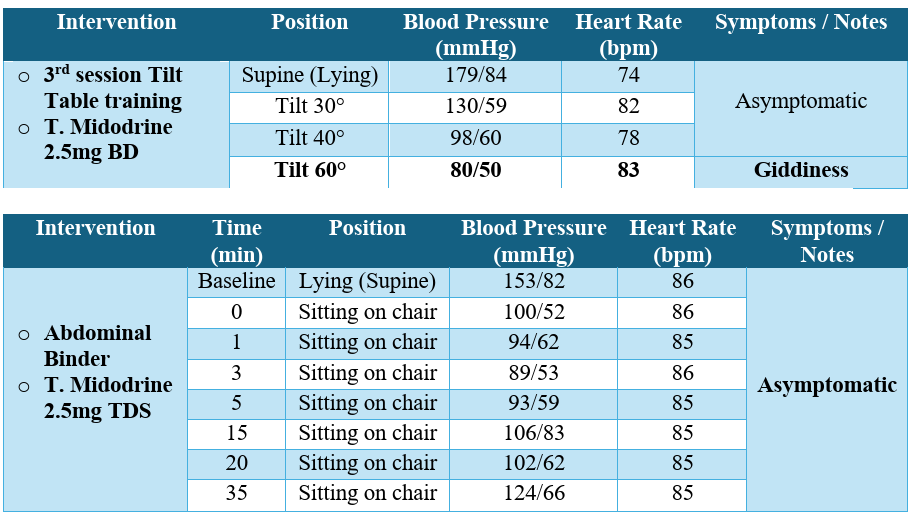

* Midodrine TDS was administered at 8:00 AM, 12:00 PM, and 4:00 PM, patient was propped up at a 45-degree angle for 4 hours following each dose of midodrine, with the final daily dose administered before late afternoon to prevent supine hypertension
Given his severe neurogenic orthostatic hypotension (nOH) and recurrent acute urinary retention (AUR) secondary to severe BPH, a long-term catheterization strategy was adopted. This decision eliminates the need for alpha-blockers, avoiding iatrogenic exacerbation of his postural hypotension, preventing recurrent urinary retention, bladder-distension-induced dysautonomia, and secondary delirium.
Clinical Questions Part 2
1. How should we navigate the therapeutic trade-off between neurogenic orthostatic hypotension (nOH) and nocturnal supine hypertension in this patient?
2. What pharmacological options are available for postural hypotension, including their recommended starting doses, dose titration, and monitoring parameters?
3. What specific physical therapy and tilt-table habituation schedules are evidence-based for transitioning severe nOH patients from seated stability to safe standing/transfers?
References:
1) Newton, J. L., & Frith, J. (2018). The efficacy of nonpharmacologic intervention for orthostatic hypotension associated with aging. Neurology, 91(7), e652–e656.
2) Figueroa, J. J., Basford, J. R., & Low, P. A. (2010). Preventing and treating orthostatic hypotension: As easy as A, B, C. Cleveland Clinic journal of medicine, 77(5), 298–306.
3) Verheyden, B., Ector, H., Aubert, A. E., & Reybrouck, T. (2008). Tilt training increases the vasoconstrictor reserve in patients with neurally mediated syncope evoked by headup tilt testing. European heart journal, 29(12), 1523–1530.
4) Hornikx M, Haemers P, Stans L, Robyns T, Garweg C, Ector J, Vandenberk B and Willems R (2024) Tilt training as a treatment for reflex syncope: a multimodal approach!?. Front. Neurosci. 18:1473687.
5) Turner, L. N., & Gorelick, P. B. (2025, September 14). Diagnosis and management of orthostatic hypotension in individuals with Parkinson disease. Practical Neurology (US)
6) Rissardo, J.P., Gadelmawla, A.F., Khalil, I., Abdulgadir, A., Bhatti, K.S., & Fornari Caprara, A.L. (2025). Epidemiology of autonomic dysfunction in Parkinson's disease (Review). Medicine International, 5, 68
7) Cattaneo, C., Fabbrini, A., Belvisi, D., Aiello, F., Marchet, F., & Fabbrini, G. (2026). Non-Motor Symptoms: The Hidden Face of Parkinson’s Disease. Cells, 15(1), 42
8) Seppi, K., et al. (2019). Update on treatments for nonmotor symptoms of Parkinson's disease: An evidence-based medicine review. Movement Disorders, 34(2), 180–198.
Answers:
Clinical Questions Part 1 :
1. What are the key clinical issues and non-motor complications affecting this patient with long-standing advanced Parkinson’s disease?
Ans: This patient has idiopathic Parkinson’s disease at Hoehn and Yahr stage 4, complicated by neurogenic orthostatic hypotension with supine hypertension, REM sleep behaviour disorder, constipation, and recurrent falls.
2. How should his overall medication regimen be adjusted to balance dopaminergic requirements against severe orthostatic hypotension and polypharmacy risks?
Ans: Perindopril and alfuzosin were withheld because they may worsen orthostatic hypotension. Madopar HBS 125 mg twice daily was commenced, then reduced to Madopar 62.5 mg each morning in view of the patient’s severe neurogenic orthostatic hypotension and recurrent falls. Madopar HBS releases levodopa/benserazide more gradually, with peak levodopa concentrations around 20–30% of those achieved with standard Madopar and reached at about three hours. This pharmacokinetic profile may help limit peak-related effects, but a lower risk of orthostatic hypotension compared with immediate-release Madopar is not established; blood pressure and symptoms require monitoring during titration.
Resource: • Roche Singapore. (2023, June). Madopar: Levodopa + benserazide [Product information]. https://assets.roche.com/f/170883/x/c3ff8d80bd/madoparpi_jun-2023.pdf • Connolly BS, Lang AE. Pharmacological Treatment of Parkinson Disease: A Review. JAMA.2014;311(16):1670–1683. doi:10.1001/jama.2014.3654
3. What evidence-based interventions (pharmacological and non-pharmacological) can address his orthostatic hypotension, sleep disturbances, and constipation?
i. Orthostatic hypotension


Resource:
Figueroa, J. J., Basford, J. R., & Low, P. A. (2010). Preventing and treating orthostatic hypotension: As easy as A, B, C. Cleveland Clinic journal of medicine, 77(5), 298–306.
Newton, J. L., & Frith, J. (2018). The efficacy of nonpharmacologic intervention for orthostatic aging. Neurology, 91(7), e652–e656. hypotension associated with •
Turner, L. N., & Gorelick, P. B. (2025, September 14). Diagnosis and management of orthostatic hypotension in individuals with Parkinson disease. Practical Neurology (US)
ii. Constipation
increasing physical activity and the consumption of fiber (e.g., psyllium) and fluids
Probiotics
A stool softener such as docusate, osmotic laxatives (for short-term use) and prokinetic agents
iii. REM sleep behaviour
Primary goal: reduce risk of injury to patient and bed partners
Modifying sleep environment (safeguard sharp furniture and weapons, padding the floor separate bed-partner)
Recommended by American Academy of Sleep Medicine 2023 (AASM) as below:

* Given this patient’s severe neurogenic orthostatic hypotension and recurrent falls, medication-related sedation or impaired balance could add to his risk. We therefore prioritised environmental safety and avoided adding RBD medication at this stage, with the plan to review if behaviours persisted or posed an ongoing risk.
4. Suggest a management strategy for his BPH and urinary retention, given that alphablockers exacerbates his postural hypotension?
Ans: Given his severe neurogenic orthostatic hypotension (nOH) and recurrent acute urinary retention (AUR) secondary to severe BPH, a long-term catheterization strategy was adopted. This decision eliminates the need for alpha-blockers, avoiding iatrogenic exacerbation of his postural hypotension, preventing recurrent urinary retention, bladder-distension-induced dysautonomia and secondary delirium.
5. Is concurrent Rivaroxaban and Aspirin (Cardiprin) therapy clinically indicated? What is the optimal strategy for his Atrial Fibrillation and underlying IHD?
Ans: The decision to discontinue Rivaroxaban while maintaining Aspirin (Cardiprin) represents an individualised risk–benefit judgement reached through shared decisionmaking. While guidelines generally favour oral anticoagulant monotherapy for atrial fibrillation and stable coronary disease as large clinical trials demonstrate that combining a NOAC with an antiplatelet significantly increases major bleeding risks without offering additional ischemic benefit. In this case, patient is moderately frail and have recurrent fall, the clinical team and family explicitly accepted the thromboembolic stroke risk to protect the patient from the immediate, catastrophic threat of a fall-related intracranial hemorrhage while on a NOAC. Retaining Cardiprin 100 mg daily serves as a practical, risk-mitigated compromise; although aspirin provides no effective protection against AF-related cardioembolic stroke, it maintains essential secondary prevention for his underlying ischemic heart disease.
Resource:
• Yasuda, S., Kaikita, K., Akao, M., Ako, J., Matoba, T., Masuda, M., Yamamoto, N., Hiromei, J., Tang, K., Taguchi, H., Yonemoto, K., Ishihara, M., Ando, K., & Nakamura, M. (2019). Antithrombotic therapy for atrial fibrillation with stable coronary disease. New England Journal of Medicine, 381(12), 11031113. doi.org
Clinical Questions Part 2
1. How should we navigate the therapeutic trade-off between neurogenic orthostatic hypotension (nOH) and nocturnal supine hypertension in this patient?
Ans: Nocturnal supine hypertension affects 34% to 50% of patients with Parkinson’s disease. Technique to prevent nocturnal supine hypertension:
§ Not take pressor medications after 6pm
Elevate head of bed to lower intracranial blood pressure
Try a bedtime snack with glass of warm fluid ( to induce nighttime postprandial hypotension)
Try a glass of wine at bedtime (for vasaodilator effects)
Remove abdominal binder before bedtime
Neurogenic orthostatic hypotension management has shown as above.
In this case, Midodrine TDS was administered at 8:00 AM, 12:00 PM, and 4:00 PM, patient was propped up at a 45-degree angle for 4 hours following each dose of midodrine, with the final daily dose administered before late afternoon to prevent supine hypertension. If the patient's overnight supine blood pressure remains significantly elevated despite head-of-bed elevation, a short-acting, bedtime antihypertensive is introduced. Avoid long acting antihypertensive.
Resource: • Figueroa, J. J., Basford, J. R., & Low, P. A. (2010). Preventing and treating orthostatic hypotension: As easy as A, B, C. Cleveland Clinic journal of medicine, 77(5), 298–306.
2. What pharmacological options are available for postural hypotension, including their recommended starting doses, dose titration, and monitoring parameters?
Ans: Refer to the table under question Part 1 No.3
3. What specific physical therapy and tilt-table habituation schedules are evidence-based for transitioning severe nOH patients from seated stability to safe standing/transfers?
Ans: Example of Physical Counter-Manoeuvres
Ankle pump exercise
Calf raises
Leg crossing
March on spot
The primary goal of tilt training is to improve orthostatic tolerance by gradually training the autonomic nervous system to handle changes in posture and enhance circulatory function and helps reduce the symptoms of orthostatic hypotension (Baltz et al., 2013).
Method
a. Slowly raised from a lying to an upright position, typically starting at 30° to 45°. b. Initially, Tilt sessions usually last 5–10 minutes
c. Gradually increasing to 20–30 minutes as the patient tolerates it.
d. Blood pressure is monitored during each session.
e. Compression stockings or abdominal binders may be used to assist circulation.
Evidence or Expert Insights:
Clinical guidelines recommend using tilt tables for daily sessions to condition the cardiovascular system in patients with SCI and other conditions prone to OH (Cowhig & Farrell, 2019).
13 patients with OH, tilt training 90 session (45-90minutes), 12/13 patients could sustain the full duration of tilt table testing without any symptom (Ector H et al 1998)
32 patients with recurrent neurocardiogenic syncope, tilt training + home exercise with standing against wall 2 months , follow up ~1 year, 81 % free of recurrent syncope (Ozan Et al 2004)
Comments